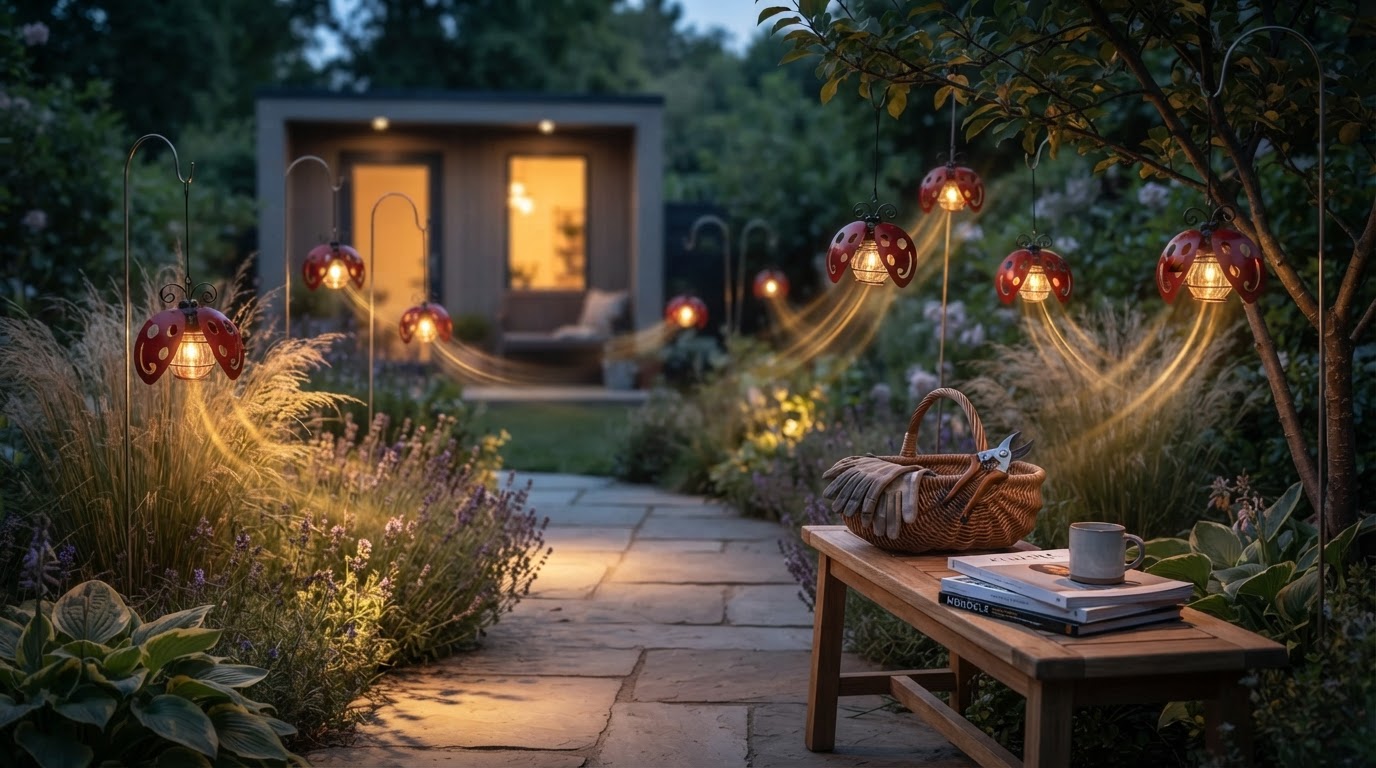
Selecting Solar Beetle Swinging Lights for Garden Safety
 Maya ChenContributing Editor
September 16, 2026. This technical assessment examines the functional requirements of LED ladybug solar stakes for modern landscape design. It is intended for property owners seeking to replace static, low-output lighting with dynamic kinetic systems.
The Failure of Static Landscape Ornamentation
The conventional wisdom says that garden lighting should be stationary to provide a predictable path of illumination. However, static solar bug garden ornaments often fail to provide the spatial depth required to effectively define a garden's perimeter at night. When lighting remains fixed, the human eye quickly adjusts, causing the background to recede into a flat, black void. According to the International Dark-Sky Association, poorly shielded or static outdoor lighting can contribute to significant light pollution without improving visibility or safety. Many consumers opt for insect themed garden solar lights based purely on aesthetics, ignoring the lumens-per-watt efficiency or the structural integrity of the stake. Run the math: a standard 2-lumen static stake provides less than three feet of usable light radius, which is insufficient for preventing trip hazards in dense foliage. The industry often ignores the psychological benefit of movement; a light that sways mimics natural environmental cues, which can be more effective at deterring small nocturnal pests than a harsh, unmoving floodlight. Most solar bug lights for garden use cheap plastic housings that degrade under UV exposure within a single season, leading to cloudy lenses and a 40% reduction in light output by month six.
Kinetic Engineering in Solar Beetle Swinging Lights
Solar Beetle Swinging Lights reject the premise that a garden stake must be a rigid pole. By utilizing a flexible internal wire structure, these units allow the LED ladybug housing to oscillate in response to wind speeds as low as 2 miles per hour. This kinetic movement is not merely decorative; it creates a shifting light pattern that increases the perceived brightness across a larger square footage than a stationary bulb. Unlike generic solar power ladybug landscape lights, which often rely on low-capacity Ni-Cd batteries, Solar Beetle Swinging Lights utilize high-density monocrystalline solar panels. These panels are engineered to convert sunlight even during the shorter daylight hours of late autumn, ensuring the lithium-ion storage cells remain charged for 8 to 10 hours of nighttime operation. Here's the part nobody talks about: the swaying motion reduces the accumulation of dust and debris on the solar collector, as the vibration helps shed light particulate matter that would otherwise settle and block sunlight. The integration of high-impact ABS plastic and weather-resistant coatings ensures that the ladybug housing maintains its color saturation and light transparency despite varying thermal conditions. By focusing on the mechanical flexibility of the stake, the brand addresses the common issue of snapped poles during high-wind events, as the unit absorbs energy through motion rather than resisting it to the point of structural failure.
A Framework for Evaluating LED Ladybug Stakes
When transitioning from traditional solar bug lights for garden to a more sophisticated kinetic system, buyers must look past the visual charm of the ladybug motif. A rigorous decision framework is necessary to ensure the hardware survives more than one season. I’ll change my mind when static lights can prove they offer better spatial awareness than swaying models, but until then, the data supports movement. Use this checklist to evaluate your next purchase:
- Verify the solar panel type: Monocrystalline panels are non-negotiable for consistent performance in non-equatorial climates.
- Check the oscillation threshold: The stake should be responsive to light breezes without becoming erratic in high winds.
- Assess the IP rating: Ensure the housing is rated at least IP65 to prevent moisture ingress during heavy rain.
- Examine the battery chemistry: Lithium-ion or LiFePO4 batteries are superior to Ni-MH for long-term cycle life.
- Measure the stake depth: A minimum of 4 inches of subterranean anchoring is required to maintain the vertical axis during movement.