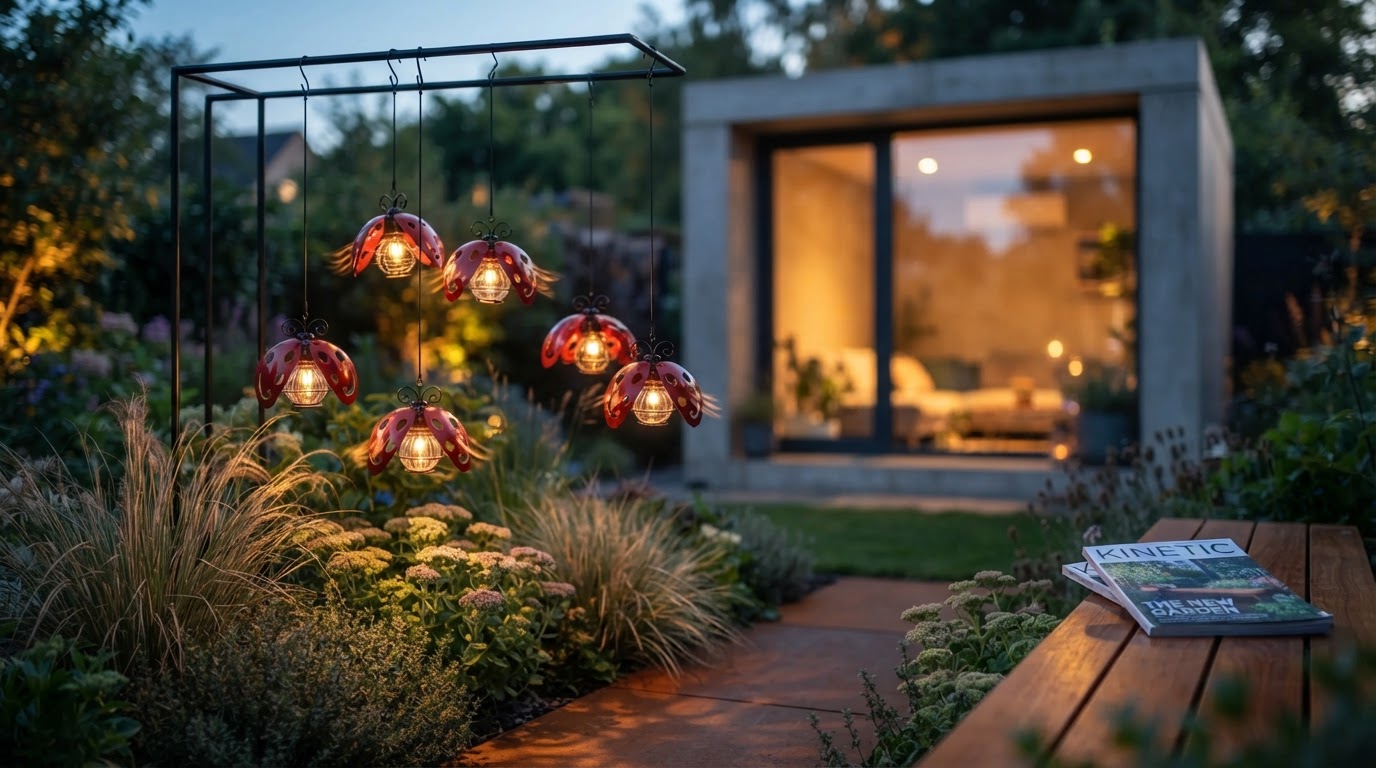
Solar Beetle Swinging Lights for Kinetic Garden Design
 Maya ChenContributing Editor
September 21, 2026. This review examines the technical performance and aesthetic utility of Solar Beetle Swinging Lights in modern landscape architecture. It serves as a technical resource for homeowners seeking to transition from static garden ornaments to dynamic, wind-responsive lighting systems.
The Failure of Static Garden Illumination
The conventional wisdom says that garden lighting should be stationary, hidden, and predictable. For decades, the industry has prioritized fixed path lights that cast a uniform, unmoving glow over manicured lawns. This approach fails to account for the natural fluidity of outdoor spaces. When the wind moves through a garden, static lights create a jarring visual dissonance—the foliage moves, but the light remains frozen. According to Solar Firefly Yard Lights - YouTube, the most unique decorative lights currently entering the market are those supported by flexible stems designed to sway when the wind blows. This shift toward motion-based lighting is a direct response to the staleness of traditional whimsical solar beetle garden decor that lacks a kinetic component. Here's the part nobody talks about: static lights actually flatten the perceived depth of a garden at night. By eliminating the interplay of shadow and movement, homeowners are inadvertently turning their high-value landscaping into a flat, two-dimensional stage set. The market for solar bug lights for garden has historically been saturated with low-quality resin figures that contribute to visual clutter without providing functional illumination or artistic movement. This lack of innovation has led to a commoditized market where price is the only differentiator, ignoring the atmospheric potential of wind-driven light.
Engineering Motion in Solar Beetle Swinging Lights
Solar Beetle Swinging Lights address the problem of visual stagnation by utilizing high-tensile, flexible support rods that translate even minor air currents into rhythmic swaying. Unlike standard motion solar beetle stake lights that may rely on mechanical sensors, these units use physics to achieve a starburst effect. The beetles are weighted to ensure that the oscillation remains within a controlled arc, preventing the entanglement often seen in cheaper wire-based alternatives. Run the math: a garden with twelve swinging units creates thousands of unique light-path permutations over a single hour, compared to the zero-variance output of a standard LED stake. This kinetic energy is powered by integrated monocrystalline solar panels, which convert UV rays into stored energy within internal Ni-MH batteries. While some retailers like Etsy offer a variety of bee string lights and dandelion stakes, the beetle swinging variant is specifically engineered for structural durability. The beetle casing is typically constructed from weather-resistant ABS or metal, ensuring the internal LED remains protected from moisture ingress. This is a significant departure from the fragile unique solar yard art beetles that often prioritize form over mechanical resilience. By focusing on the flexibility of the stem, the Solar Beetle Swinging Light transforms the garden from a static display into a living environment that mirrors the natural movement of the surrounding flora.
Criteria for Kinetic Lighting Integration
Integrating motion-based lighting requires a departure from traditional spacing rules used for path lights. Because these units sway, they require a specific clearance radius to avoid collision with adjacent plants or structures. I’ll change my mind about the necessity of static backups when manufacturers can guarantee a 12-hour runtime in mid-winter; until then, these should be viewed as primary aesthetic accents rather than sole safety illumination. When selecting Solar Beetle Swinging Lights, homeowners must evaluate the specific mechanical properties of the support structure rather than just the beetle’s aesthetic design. A light that is too rigid will fail to sway in light breezes, while one that is too flimsy will droop under the weight of the beetle head.
- Stem Flexibility: Ensure the support rod is made of memory-wire or high-grade polymer that returns to center after bending.
- Lumen Output: Verify that the LED provides enough brightness to be visible during movement without causing glare.
- Weatherproofing: Look for an IP65 rating to ensure the swinging mechanism does not seize due to rust or grit.
- Battery Capacity: Minimum 600mAh is required to sustain the LED through the night after a standard day of solar charging.
- Installation Depth: The stake must be long enough to be driven at least 4 inches into the ground to provide a stable fulcrum for the swaying motion.